
The Fraud Boss Doesn't Need Your Password. He Needs Your Deadline.
Scam operations manufacture urgency because deadlines bypass review. Why escrow's public closing calendar is an attack surface, and what the file should show when time pressure hits.

Nobody has to steal your closing date. It is in the purchase agreement, the loan docs, the agent's countdown post, and every email thread on the file.
INTERPOL's Operation First Light 2026 — 5,811 arrests across 97 countries, USD 293 million intercepted — targeted operations that run on social engineering, which the agency defines as working a person's trust to obtain money. Read the casework and a second ingredient shows up next to trust every time: manufactured time pressure. In Macao, callers posing as officials pushed a target toward transferring nearly USD 372,000 under an urgent "fraud investigation."
The Economist's Scam Inc series showed these operations as staffed, scripted businesses. In that world, urgency is not a scammer's personality. It is a line in the script, kept because it works.
And in escrow, the criminals do not have to manufacture the deadline.
You did.
Why escrow should care
Escrow is one of the few businesses whose money-movement schedule is broadcast in advance to everyone in the transaction — and, through them, to anyone who compromises a single inbox along the chain.
That makes deadline-timed pressure the default entry point, not a clever trick. It makes funding-day afternoons the highest-risk hours on the calendar. And the public calendar means the other side can rehearse: the same pressure script can be aimed at a hundred offices in the same week, each at its own 2:35.
Offices do not get to opt out of deadlines. They do get to decide, in advance and in writing, that no deadline reclassifies the pre-release review as optional — and to make that decision once, on a calm morning, instead of at 2:35 under fire.
Deadlines convert checking into friction
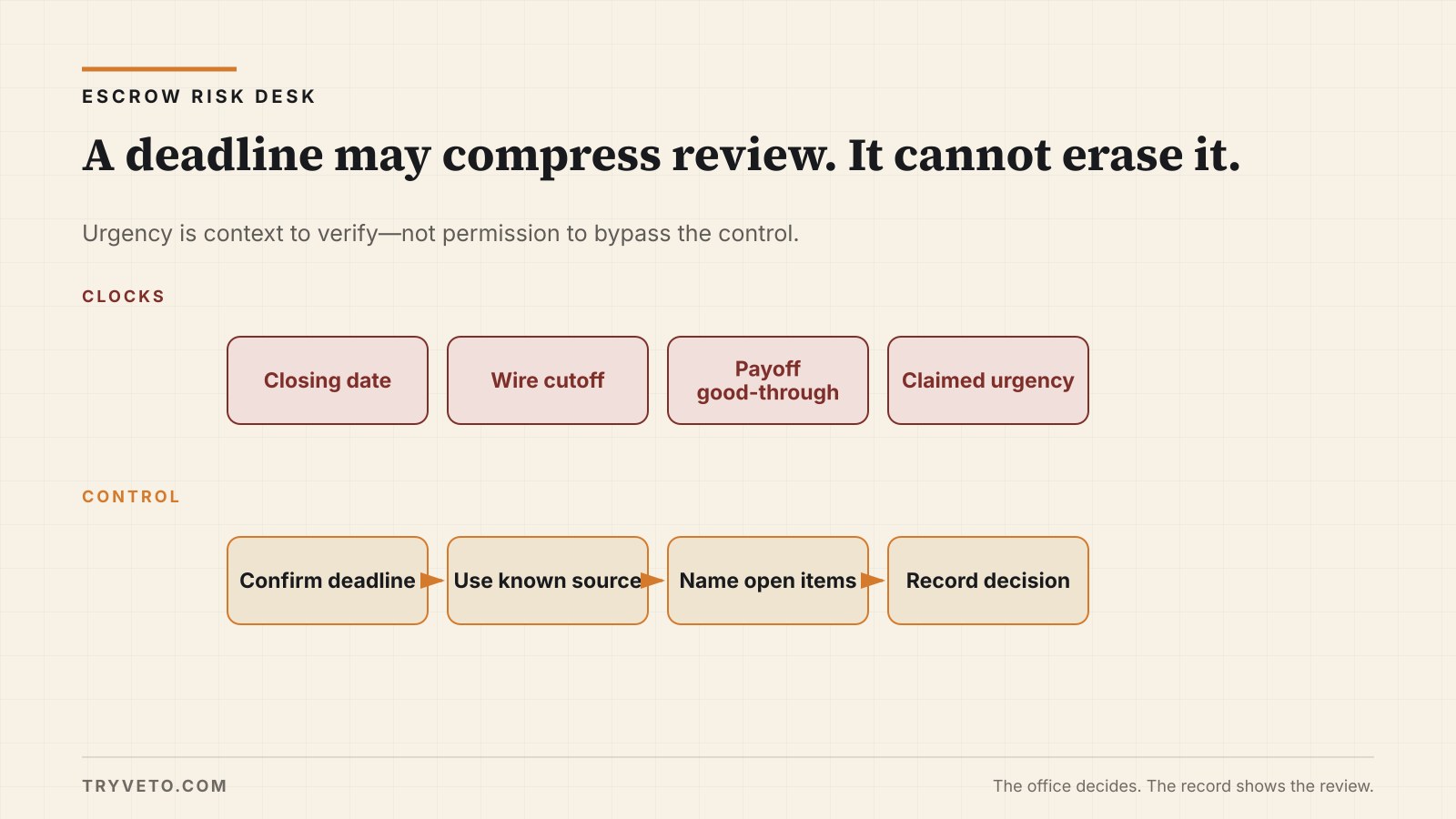
Consider what a deadline does to a review.
On a quiet Tuesday, calling the payoff bank at the number from the demand on file is just the job. At 2:35 on funding day — 3:00 cutoff, buyer's family in a moving truck, two agents on hold — the same call becomes an obstacle to everyone's happiness. The officer who pauses feels like the problem. The officer who proceeds feels like a hero, right up until the moment they are not.
None of that describes a careless office. It describes a good one, on a Friday.
Fraud timed to that window is not beating your controls. It is arranging for your controls to feel optional. The changed instructions at 4:40 the day before funding. The "corrected" payoff an hour before cutoff. The lender rep who "needs this out today or the rate lock dies." Each one converts a check the office would normally run into a delay the office must now justify.
That inversion is the whole attack. There is no malware in it. There is a countdown, and a bet that your process yields to it.
Our guide on agent pressure to close early covers the legitimate version of this squeeze — and the fraudulent version uses identical language, which is the point. At 2:35, from the officer's chair, they cannot be told apart by tone. They can only be told apart by the file.
Urgency is a control failure, not a service level
An office can honor a deadline or miss a deadline, and both can be fine. What an office cannot do is let a deadline delete a review.
When "we didn't have time to check" appears anywhere near a disbursement, that is not a scheduling outcome. It is a control failure with a countdown attached, and it reads that way to an examiner, a carrier, and opposing counsel.
This is why the response to pressure should be scripted before the pressure exists. An officer improvising at the cutoff will negotiate. An officer with an office-issued sentence will not have to: "Our office confirms every instruction change before funds move — I can have this done within the hour." It holds the line while sounding like service, and it works because the owner decided it on a calm morning, not the officer at the cutoff.
The workable standard is narrower and more honest than "never rush." Time pressure may compress a review. The review still happens, and it still gets written down — including, when needed, a line saying what could not be finished in the time available, and who accepted proceeding anyway.
A file can survive "we checked A and B; C stayed open; owner accepted the exception at 2:51."
A file cannot survive silence.
What should be written down before money moves
Before the money moves, the file should answer five questions:
- What changed.
- What was checked, and against which source.
- What stayed open.
- Who reviewed.
- What the office did.
Under deadline pressure, two of those get sharper. The deadline goes in twice: as claimed by the requester, and as confirmed by a document in the file — the contract, the lock confirmation, the payoff's good-through date — with a note when the two do not match. And every entry gets a time, because in a deadline story, timestamps are the plot.
A record showing the review took eleven minutes is also a record proving the deadline never required skipping it.
Operator takeaway
Assume every deadline-citing request was designed for the moment it arrived, and hand your officers the sentence in advance: "We can move fast, and we still write it down."
Speed is a service. Silence is not.
A deadline can move a wire up.
It cannot move the review out.
— Sebastian Heyneman
Sources
- Over 5,800 arrests, USD 293 million intercepted in global fraud bust (INTERPOL, July 9, 2026)
- Scam Inc from The Economist (Apple Podcasts)
- Related on this blog: When a Real Estate Agent Pressures You to Close Early
Boundaries: INTERPOL figures and the Macao case are as reported by the agency. The reading of urgency as a scripted line item comes from Scam Inc's account of how operations are staffed; the escrow application is ours. Neither source describes an escrow transaction.
See a sample Review Record.
One page showing what changed, what was checked, what stayed open, and who reviewed it.