
Policy controls
Define covered instructions, required sources, freshness windows, and exception paths.
Veto requires a current Review Record — sources, limitations, and a recorded exception path — before consequential settlement-funds actions happen.
Founder, Veto · Secretary, Orange County Escrow Association
The first escrow officer Sebastian met told him, “One bad wire, and it feels existential.” He started Veto to give escrow teams a clear, file-ready record of what the office reviewed before funds move — built from months inside escrow offices learning how callbacks break and where wire-fraud risk actually shows up.
Before Veto, Sebastian built data infrastructure for a bond-trading team at Millennium and joined early data teams at Notion, Asana, and 11x.
The next generation of fraud will not mainly exploit missing data. It will exploit credible impersonation at the moment of action — believable emails, voice calls, documents, IDs, and signatures.
Permission to act is an office state — created by policy, evidence, source limitations, role, timing, and record. That is Veto.
Verification vendors, systems of record, and reconciliation tools each do real work. None of them stop a release on a stale or unsupported record.
Veto sits on top of these tools — it doesn't replace them. It turns what they output into a controlled, recorded decision to act.
Offices already store, verify, route, reconcile, and pay. None of those tools create a clean answer to the one question that matters after a loss.
Veto controls the moment an office converts mutable evidence into an accepted state — and then acts on it.
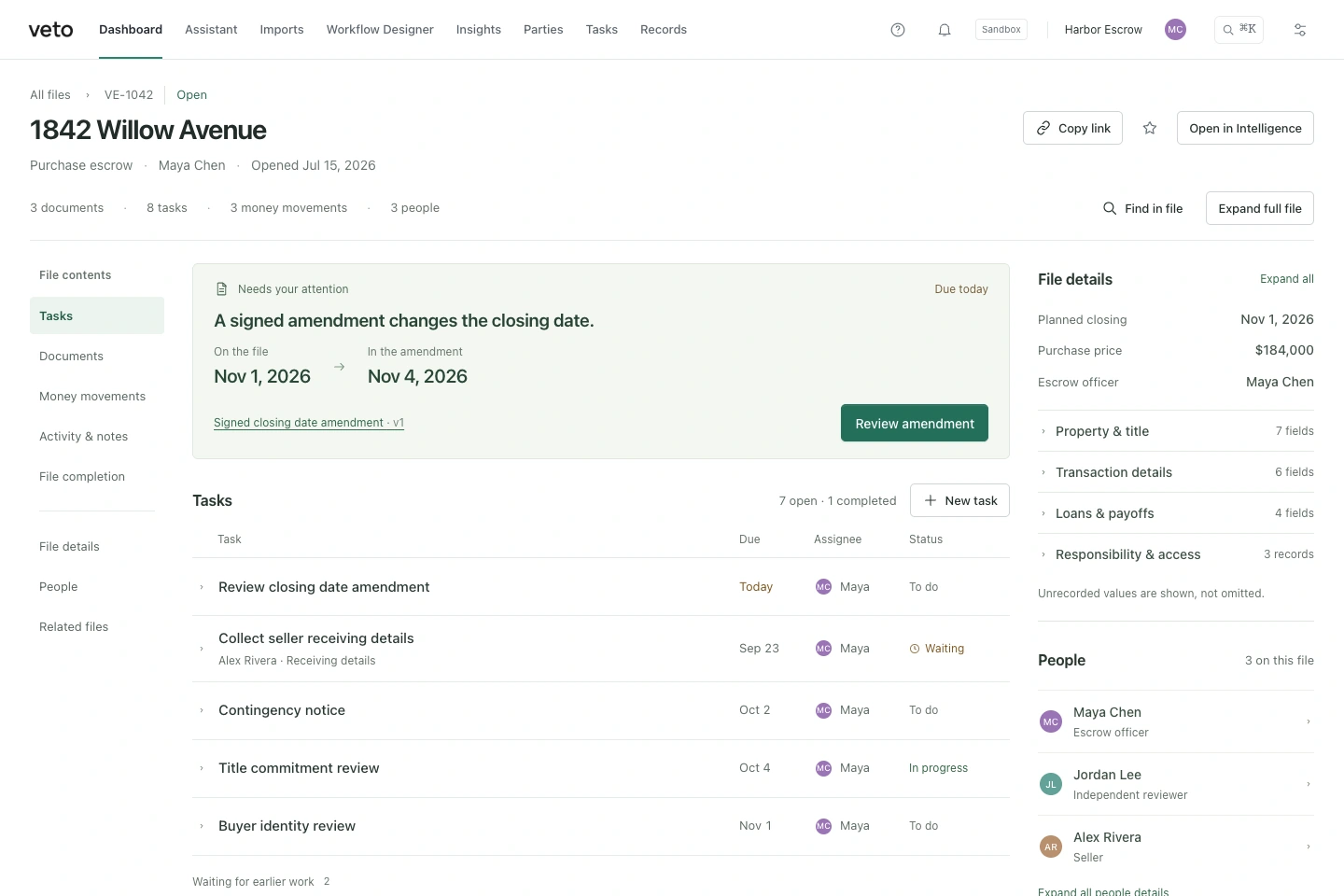
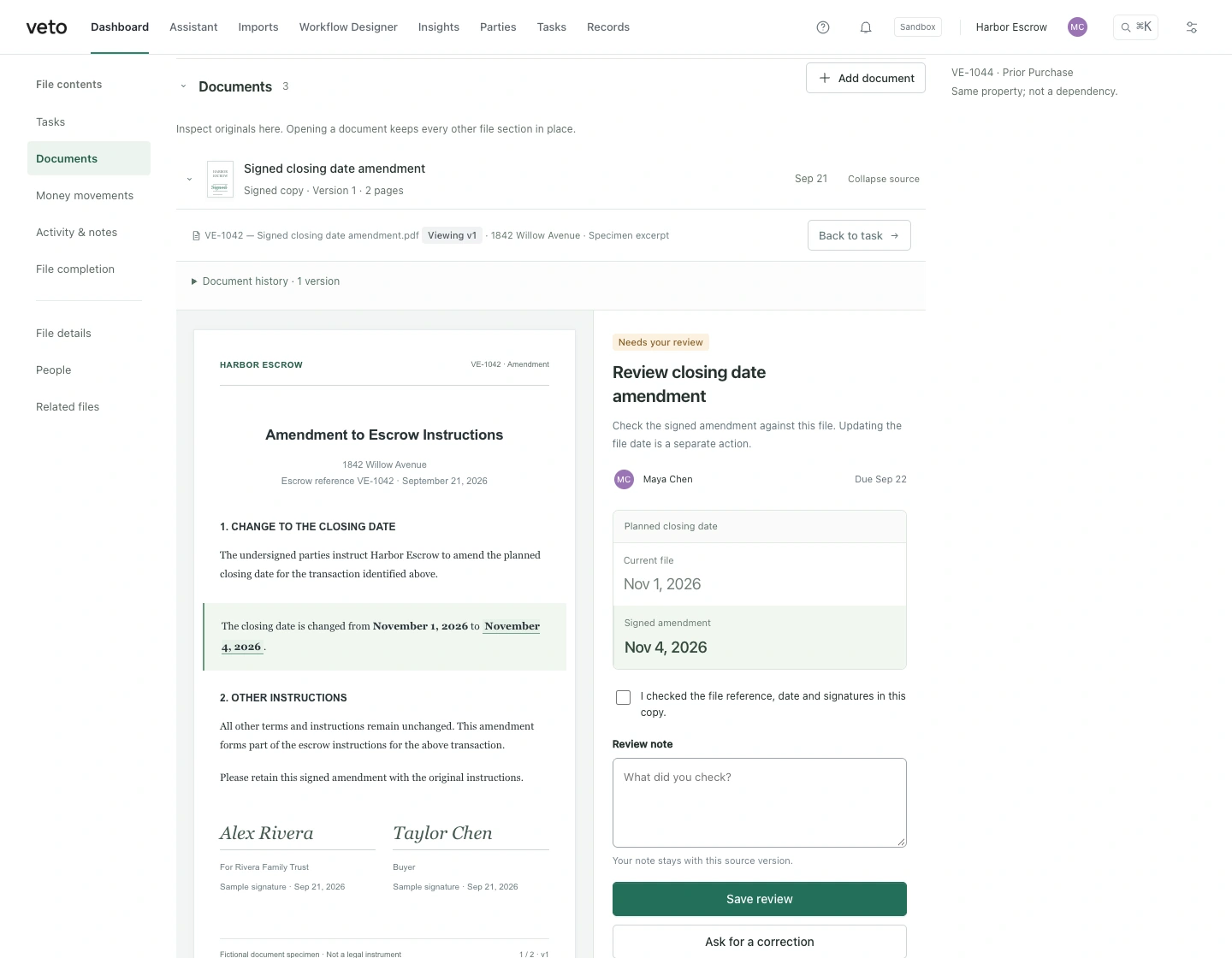
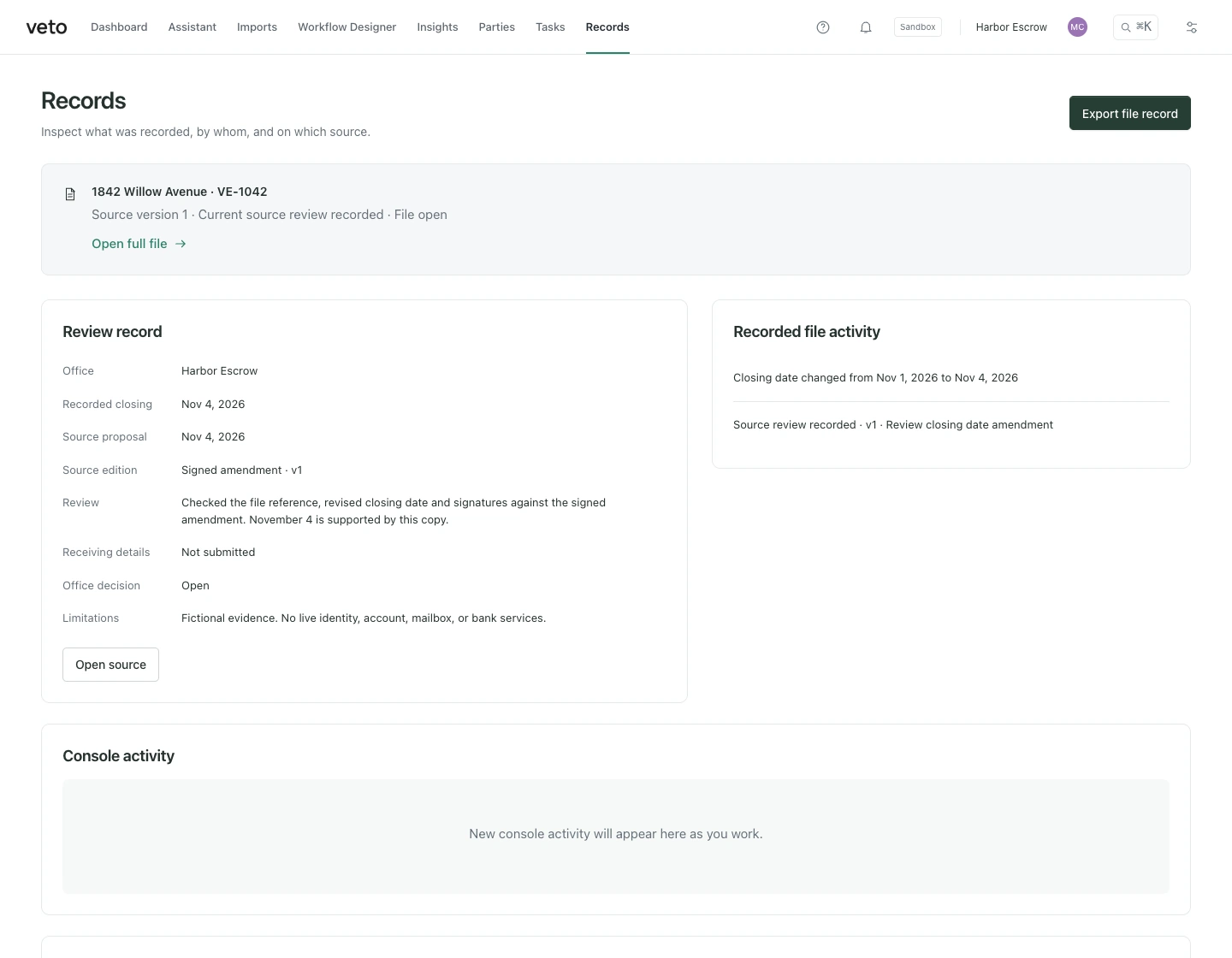
Every covered instruction produces a Review Record: the instruction, the accepted state, the sources reviewed, the limitations that remain, what changed since the prior state, and who signed off.
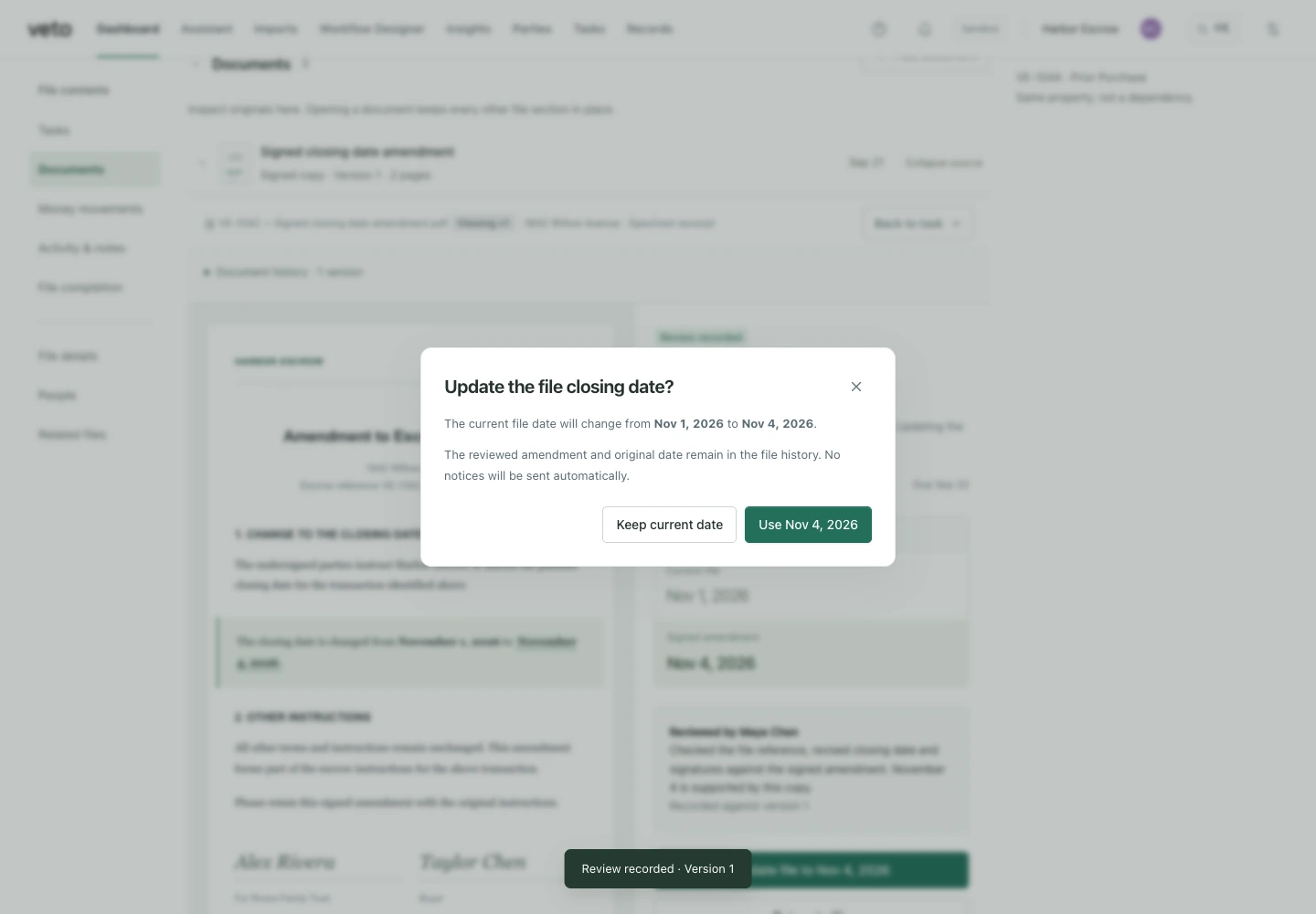
It is written to read like part of the closing file — not a vendor receipt. When a material value changes after sign-off, the record goes stale, the instruction is blocked, and a v2 record or owner-approved exception is required.
See a full Review Record →Every piece of evidence becomes a source row that states what it supports and, in plain language, what it does not prove. The limitation is visible on the record — never buried in a provider response.
An account match supports account existence and a payee-name match. It does not prove live bank confirmation, account control, or permission to release funds. Veto makes that distinction part of the file.
You choose the instructions that cannot proceed without review. The Review Register shows the owner whether the rule was followed — current, stale, exceptioned, or missing.
A payoff amount, a destination account, a settlement statement, a signer: when a material value changes after a Review Record is signed, the prior record is superseded and the covered instruction is blocked.
No one has to remember to re-check. The block holds until a v2 record is signed or an owner approves an exception with the limitation named.
When policy requires it, an officer requests an exception. The approver sees the sources, the limitation, the action, and the reason before deciding. The exception, the approver, and the reason all land on the record.
The green path compresses to under sixty seconds. The exception path is impossible to hide.
The same kernel runs escrow today and other fiduciary money releases next. Escrow is the first domain pack.
Define covered instructions, required sources, freshness windows, and exception paths.
Every claim a source supports — and, in plain language, what it does not prove.
Not a generic todo list. Each item is an obligation to resolve a file-state gap.
File-native records of what was reviewed before a covered instruction was acted on.
Release support that expires and invalidates the moment a material value changes.
When activity data exists, compare what actually moved against the Review Record.
Account numbers, IDs, and raw provider responses with field-level access and logs.
Material changes, alerts, holds, and incidents across every open file.
Coverage reporting that says control configured — never “certified safe.”
A source supports a claim. It does not become true by existing.
An account match, identity result, callback, or extraction does not authorize action.
Model covered instructions and controlled actions — not just files, documents, or tasks.
Limitations belong on the Review Record, not hidden inside provider responses.
If a file state changes after reliance, prior records become stale, superseded, or void.
If the office would bypass the control on a busy Friday, it has not yet become required.
Veto Standard maps covered-instruction controls to ALTA Best Practices, office policy, underwriter expectations, and E&O questions.
It never claims a file is safe, fraud-cleared, or legally approved. It reports what is actually true: control configured, Review Record present, limitations visible, exception recorded.
Explore Veto StandardVeto does not start as a broker, MGA, or guarantee. It starts as the system that produces underwriting-grade Review Records — turning fuzzy social-engineering risk into structured, observable control data.
Controls create Review Records.
Records create structured telemetry.
Telemetry makes risk observable.
Observable risk becomes underwritable.
The office decides and acts under its escrow instructions and policies.
Fiduciaries don't buy infrastructure because it's elegant. They adopt controls because the absence of controls creates blame, loss, and exposure.
A fast green path to a defensible record — and an exception path when the file isn't clean.
The Review Register shows whether covered instructions had current records or approved exceptions.
A queue of policy-generated obligations to resolve — not a generic todo list.
Release support that expires and invalidates the moment a material value changes.
Field-level access to sensitive evidence, with every view logged in the Vault.
An audit packet with policy version, source manifest, event log, exceptions, and record status.
Every fiduciary organization now needs a control layer between communication and action.
Veto Company ThesisBefore Veto sold anything, we built tools the escrow and title community uses for free — from public data, with no regulator affiliation.
998 DFPI-licensed California escrow offices on one map, built from public data.
Visit escrowmap.org ↗Reviewed public court records — what happened, what documents mattered, what the file had to show.
Visit escrowcases.org ↗Key escrow and title industry dates, meetings, and deadlines, kept in one place.
Visit escrowcalendar.org ↗Adoption is owner-led and policy-led. Start with one covered instruction; expand control by control.