
A File Can Be Complete and Wrong at the Same Time
Wire risk in escrow concentrates at the release moment, when earlier confirmations may be stale. What a release-time record should capture before trust funds move.
A forty-five-day escrow ends at one desk, in the few minutes it takes one person to release the money.
Weeks of documents, signatures, demands, amendments, and calls narrow to that point. Everything before it is preparation. Everything after it is history.
All of the wire risk in the file — every changed instruction, every aging confirmation, every assumption formed in week two and never revisited — collapses into the same minutes. It is the moment every script in The Economist's Scam Inc reporting is built to reach. It is the moment Singapore's Anti-Scam Centre spent public money to intercept. It is the moment after which recovery becomes a request instead of a decision.
The release decides the whole game. It is strange, then, how rarely the release itself gets a record.
Why escrow should care
After a bad wire, every question from every direction — bank, carrier, examiner, principals, counsel — is the same question wearing different letterhead: what did the office know and check at the moment of release?
Not at opening. Not in week two. At release.
An office whose documentation clusters at the front of the file will reconstruct that moment from fragments and memory, months later, under oath. An office that spent five minutes writing the release page has the answer sitting in the file, dated and signed, before anyone thought to ask. Five minutes, against the defining moment of the office's liability.
The opening is documented. The release usually isn't.
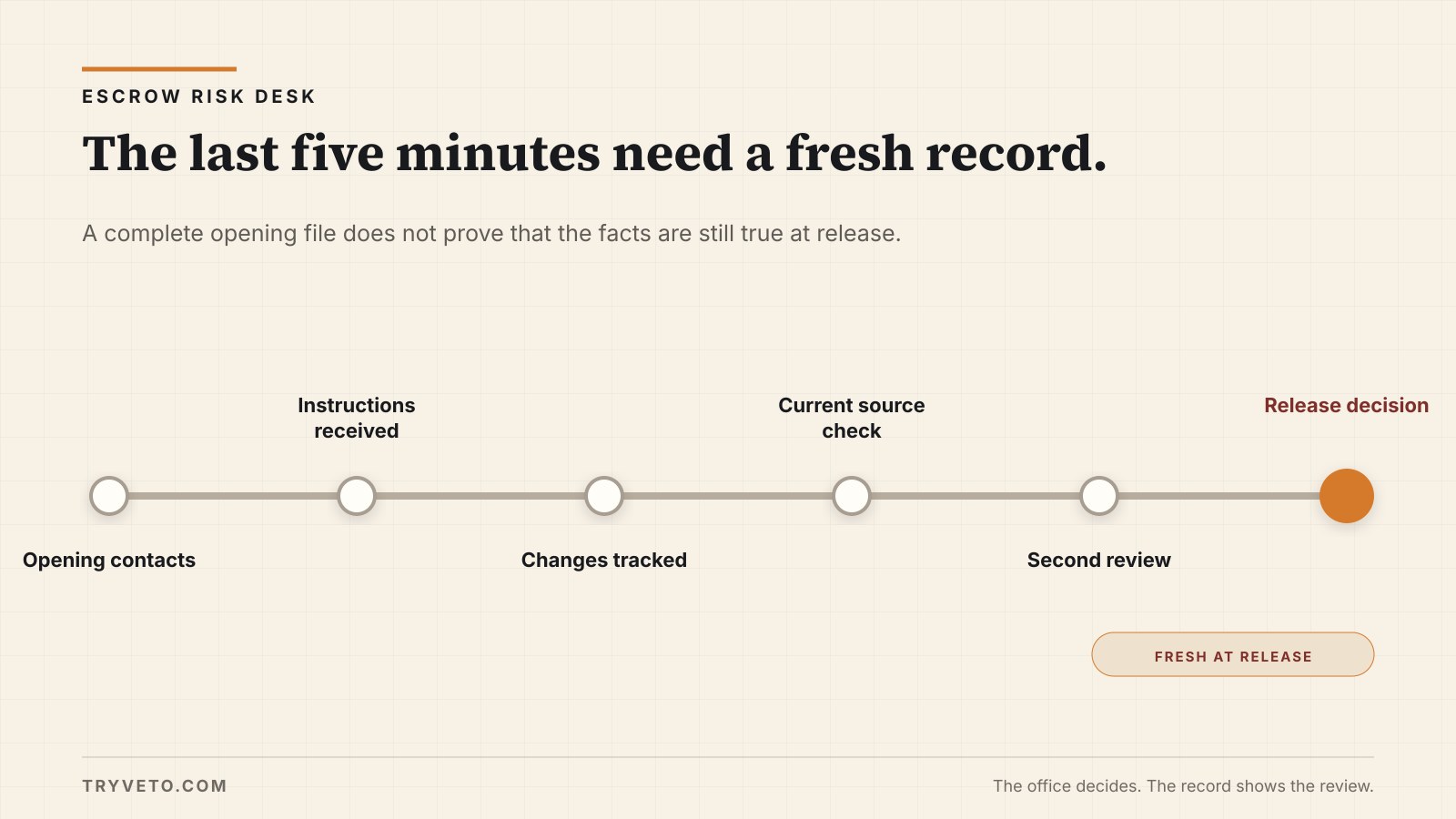
Walk a typical file and watch where the paper clusters. Opening: thorough. Instructions, statements of information, contact details, the initial wire instructions — collected, dated, filed. Mid-file: decent. Amendments and demands come in and get slotted.
Now find the artifact that documents the release decision itself. In many offices it does not exist as its own thing.
Run the test on your own last ten funded files. On how many can you point to the page that documents the release — not the opening, the release?
This is not sloppiness. Offices document openings because openings are when documentation was taught to happen — by training, by checklists, by every audit that ever looked at a new file. The release inherits its justification from work done days or weeks earlier: the payoff was checked when it arrived, the seller's instructions were confirmed at opening, the callback happened at some point.
So the final act — the only irreversible one — rides on a stack of confirmations of unknown freshness. The file shows that checks occurred. It does not show what was true at the moment that mattered.
That gap is where late changes live. Our guide on stale records and material changes makes the mechanical point: a file can be complete and wrong at the same time, because completeness is measured against the past and wires fund in the present. The payoff demand in the folder was accurate on the 14th. The instructions were confirmed on the 3rd. It is the 28th.
What, exactly, is known to be current right now?
What a release-time record looks like
The fix is not more ritual spread across the file. It is one deliberate snapshot, taken at the point of no return — the file's version of a pilot's final checklist, which exists because the walkaround two hours ago is not evidence about the aircraft now.
At release, someone answers in writing. Which version of the wire instructions is in force, and when did it last change. Whether the payoff demand is inside its good-through date — the date on the document, not a recollection of it. When the destination was last confirmed, against which source row, by whom. What changed on the file in the last seventy-two hours, and whether each change was reviewed.
And what is still open. The honest answer is sometimes "nothing," which is worth writing too — "no open items, reviewed by DK, 1:47pm" is a sentence with real weight later.
The snapshot is not a re-review of the whole file. Most lines will reference work already done, with dates. Its job is narrow: force the freshness question — as of now? — onto the handful of facts a wire depends on, and leave a page proving the question was asked.
What should be written down before money moves
Before the money moves, the file should answer five questions:
- What changed.
- What was checked, and against which source.
- What stayed open.
- Who reviewed.
- What the office did.
At release, the questions come with dates attached. The instruction version being funded against, and the date of its last change. The payoff's issue and good-through dates as printed. The destination confirmation — when it was performed, from which source row, who was reached, by whom. Open items retained in plain words, or an explicit "none." Reviewer, time, and the office's decision: released, or held pending an owner exception.
If anything proceeds with an item open, the name of the person who accepted that belongs on the page. Not as blame. Ownership recorded calmly today is ownership nobody has to assign in a conference room later.
Operator takeaway
Stop treating the release as the end of the paperwork. It is the event the paperwork exists for. Give the last five minutes their own page: what is in force, what is fresh, what is open, who decided.
The wire is the only thing in the file the office cannot take back.
It should be the best-documented thing in it.
— Sebastian Heyneman
Sources
- Anti-Scam Centre and five banks foil over 600 scam attempts (Singapore Police Force, July 7, 2026)
- Scam Inc from The Economist (Apple Podcasts)
- Related on this blog: How to Manage Stale Records and Material Changes in Closing Files
Boundaries: the Singapore figures are as reported by the Singapore Police Force, about consumer scams, in what is presumably Singapore dollars; Scam Inc is cited for how operations are built, on the series' own account. Neither source examined escrow releases. The claim that release-time documentation is thin in many offices is a field observation, not a dataset.
See a sample Review Record.
One page showing what changed, what was checked, what stayed open, and who reviewed it.