
Scam Inc. Has a Workflow Now
The Economist's Scam Inc describes fraud as an industry with recruiting, scripts, and laundering desks. What that means for the review record in a California escrow file.

Scam Inc, an eight-part podcast from The Economist, opens with the collapse of a bank in rural Kansas.
It follows the money from that failure into a global industry the show says already rivals the illicit drug trade. This year the series won a Peabody Award.
It is not a crime story. It is a business story. One episode's own description promises "perks, outsourcing and a monthly landscaping budget."
That line is not a joke about criminals playing office. It is the finding.
Why escrow should care
Escrow moves other people's money, on deadlines, and the phone number is on the website. That is the transaction profile an industrialized operation is built to probe.
A seller wire change. A payoff redirect. A last-minute update from a "lender." These are not exotic attacks. They are standard entries in a playbook, kept because they work often enough at scale.
And when one lands, every question that follows — from the bank, the carrier, the principals, the DFPI — is a question about what the review looked like before release. An office that answers with a page from the file is in a different position than an office that answers with a recollection.
The other side has an org chart
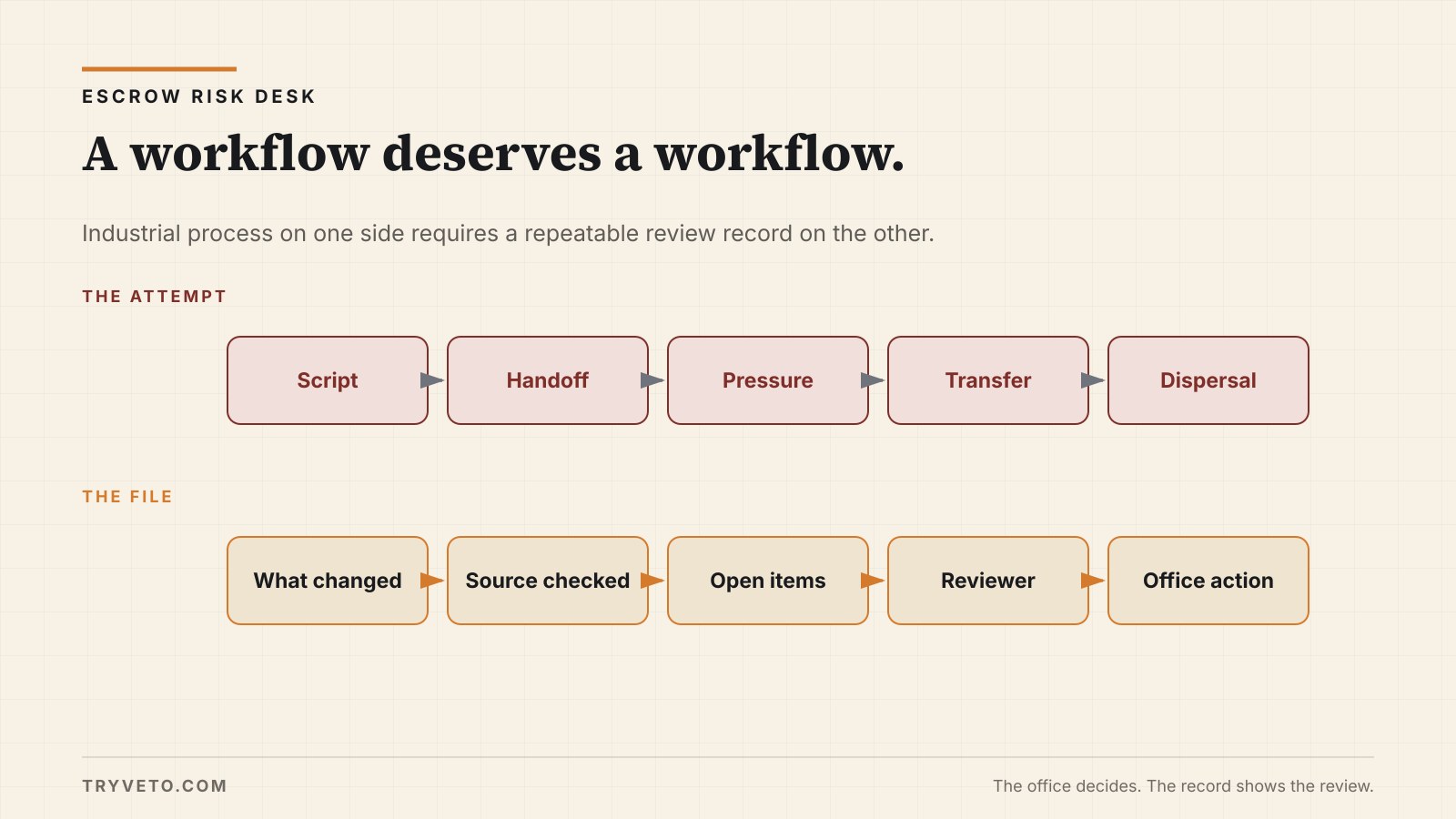
The picture the series assembles is fraud with departments.
There are people whose job is recruiting — often through deception, and in the compounds the reporting describes, through human trafficking. People who write scripts and revise them after every failure. People who run the conversation, people who take the handoff when a target gets close to sending, people whose only job is moving money afterward. Management. Quotas.
I want to say the fair thing before the useful thing: nothing in the series is about escrow. The compounds it describes run romance and investment scripts against consumers, not closing files. If you listen expecting your industry, you will not hear it.
What transfers is the structure.
The email asking to update the seller's wire instructions two days before closing was not composed for you. Some version of it went out before, got revised after it failed, and went out again. The caller from the "lender's funding department" may be on the fortieth call of the week, running the same pressure sequence.
So when a contact feels smooth — right names, right file number, a plausible reason the change is urgent — smoothness is not reassurance. Smoothness is what a refined script feels like from the receiving end.
And an industrial operation does not need your office. It needs volume. A workflow that touches thousands of transactions only has to find the day the review is thin: the officer covering two desks, the change that arrived at 4:40, the confirmation that happened in someone's head instead of in the file.
One more department deserves a minute: the laundering desk. Once funds land, a specialist whose whole job is dispersal takes over, and recovery becomes a race the office has already missed the start of. Whatever the office is going to know about a transfer, it has to know before release. That is the only window the review covers. It is also the only window the office controls.
Improvisation loses to process
Your officers are not the weak point in this story. The checks are usually happening. Officers do compare new instructions to the file. They do call a number they already trust. They do notice a stale payoff demand.
What is missing is not diligence. It is the artifact.
When the review lives in memory, the office cannot show it happened, cannot show what stayed open at decision time, and cannot learn from its own close calls the way the other side learns from theirs. We wrote about that asymmetry when the INTERPOL enforcement numbers came out: the fraud economy scaled its process. Most escrow files did not.
A fraud operation improves because every failed attempt teaches it something. An office can run the same loop in reverse — but only if the attempts that bounce off get written down. The change email a sharp processor caught in March should exist as a dated note, not a lunch story, because the June version of that email will arrive on a different desk.
The only durable answer to a workflow is a workflow. Not a bigger one. A written one.
What should be written down before money moves
Before the money moves, the file should answer five questions:
- What changed.
- What was checked, and against which source.
- What stayed open.
- Who reviewed.
- What the office did.
On this desk, that means the change request itself, with channel and timestamp. The source row it was compared against — the number or document already in the file, not the one supplied with the request. Anything that did not match, retained as an open item instead of assumed closed. The reviewer's name and the time. And the decision, as the office's own status: released, or held pending an owner exception.
On a clean file that is two minutes of writing. On the file that goes wrong, it is the office's side of the story.
Operator takeaway
Treat every instruction change as the output of someone else's process, because it probably is.
The counter is not suspicion of every counterparty. It is a review written down the same way every time, on every file, so the one file that matters looks like all the others.
Their process learns from every attempt.
Your file should remember every review.
— Sebastian Heyneman
Sources
- Scam Inc, from The Economist — eight episodes, reported by Sue-Lin Wong; 2026 Peabody Award winner
- Related on this blog: The Fraud Industry Has Scaled. Escrow Review Records Have Not.
Boundaries: the claim that this industry rivals the illicit drug trade is the series' own sizing, repeated here with attribution, not an independent estimate. Operational details are as reported by The Economist. The series does not cover escrow; what transfers is the structure, and that judgment is ours.
See a sample Review Record.
One page showing what changed, what was checked, what stayed open, and who reviewed it.