Can your file prove the disbursement review?
A 10-minute self-audit for seller proceeds and other high-risk outgoing funds.
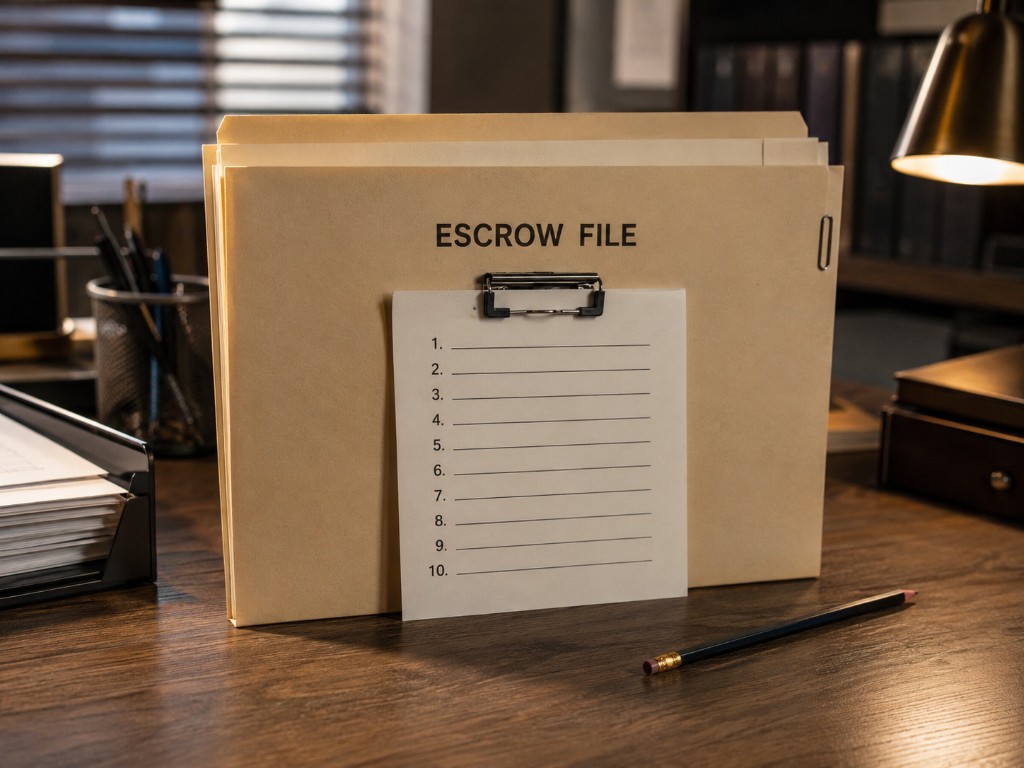
Most escrow offices already do the review before high-risk funds move. Changed seller proceeds. Payoff demands. Last-minute wiring instructions. Refunds or commissions where something does not match what was on file.
The problem is not the review. The problem is the record.
Six months from now, if an auditor, an attorney, an insurer, or a regulator asks what was checked on a specific disbursement — can the file answer? Not from memory. Not from the operator who handled it. Not from the email thread that might still exist. From the file itself.
For most offices, the honest answer is: probably not. The review happened. The proof is scattered.
The self-audit. Pick one recent closed or redacted disbursement file — seller proceeds, payoff, refund, or other outgoing funds you would not release without a second look. Open the file. Answer these 10 questions using only what is in the file record. Not what you remember. Not what is in your inbox. What the file itself can prove.
- 1. What triggered the review? Changed proceeds? New payoff demand? Updated wire instructions? Different bank or account? The file should show why this particular disbursement got a second look.
- 2. What instruction was under review? The actual instruction that would have moved funds — amount, payee, bank, routing, reference — not a summary sticky note.
- 3. What channel did it arrive through? Email, portal, fax, phone, broker forward, borrower upload. The channel is part of the evidence.
- 4. What material fields were captured? Amount, payee name, bank, routing and account numbers, good-through or timing fields, and contact information tied to the instruction.
- 5. What was the independent source? NMLS lookup, callback to a number from a prior file or public registry — not only the number printed on the instruction itself.
- 6. What checks were completed? Routing lookup, account or payee check, institution lookup, domain check, callback. The file should show which checks were done and which were not — a blank is ambiguous.
- 7. What matched? When routing matches the institution, when the payee name aligns with prior instructions, when amounts match what was expected — the file should show what compared favorably.
- 8. What stayed open? What did not match, could not be checked, or was flagged but not resolved? Open items with a documented decision are stronger than a clean file where nobody looked.
- 9. What did the office do? Released, held, escalated, returned, or released with a documented exception. The file should record the decision, not just the evidence.
- 10. Who signed, and when? Reviewer name and role, timestamp, and whether funds had already moved at sign-off. A review signed before disbursement is evidence of due diligence; after disbursement is documentation, not prevention.
Score it. Eight to ten questions answered from the file alone: the file can prove the review. Five to seven: the review happened, but proof has gaps. Under five: the review probably happened; the file cannot prove it. This is not a judgment on the operator — it is a judgment on the record.
What each check can and cannot prove. Account checks may confirm existence without payee authentication on institutional accounts. Routing lookup confirms the institution, not the account owner. Callbacks are strong verbal evidence unless written reconfirmation is obtained. NMLS confirms the entity exists — not that the instruction came from that entity. The file should show what each check found and what it does not prove.
If your file scored well, you are already doing the work. If it did not — and you want to see what the record version looks like — start one Veto Record on a closed or redacted file. The question is simple: does this belong in the file, or is it extra paperwork?
Would it be unreasonable to try this on one closed or redacted disbursement file?
Start one Veto Record →Or try a sample with fictional data.