
The Scammers Built a Police Station. It Only Had to Work on Camera.
INTERPOL found a replica police station built for video calls. Why authority cues are props — and files need evidence.

Somewhere in Eswatini, police walked into a building and found another police station inside it.
The detail comes from INTERPOL's announcement this week of Operation First Light 2026, a coordinated action across 97 countries. Between January and April it produced 5,811 arrests and intercepted USD 293 million.
In Eswatini, authorities arrested 82 people and seized 240 electronic devices, foreign currency — and a working replica of a Brazilian police station, with fake uniforms, signage, and equipment. The set had one job. On video calls, the crew posed as Brazil's Federal Police, told targets they were victims of a crime, and talked them into transferring money for "safekeeping."
Read that again. The fraud did not begin with a hacked account or a forged document.
It began with a costume, a backdrop, and a title.
Why escrow should care
Escrow is a business where strangers with titles routinely direct large sums. Lenders. Banks. Attorneys. Agents. Government agencies.
That makes manufactured authority the cheapest attack on an escrow desk. No intrusion required. Just a claim confident enough to displace a check.
An escrow office also sees more legitimate authority in a week than most businesses see in a year. That is exactly why the forged kind aims here — it expects to blend in.
And when a claimed authority later proves false, the office that recorded its check holds a defensible file. The office that deferred to a title holds a story.
Authority is a manufactured input
The same operation logged the pattern everywhere. In Macao, callers posing as public officials had a resident ready to transfer nearly USD 372,000 under the guise of a fraud investigation; police reached her first, at a community outreach event. INTERPOL's financial crime lead described the whole category as syndicates working on human psychology.
Two fair things before the point. Nothing in the release involves an escrow office — the targets were consumers. And it would be a mistake to laugh at the cardboard station: the set was worth building precisely because cues work on careful people.
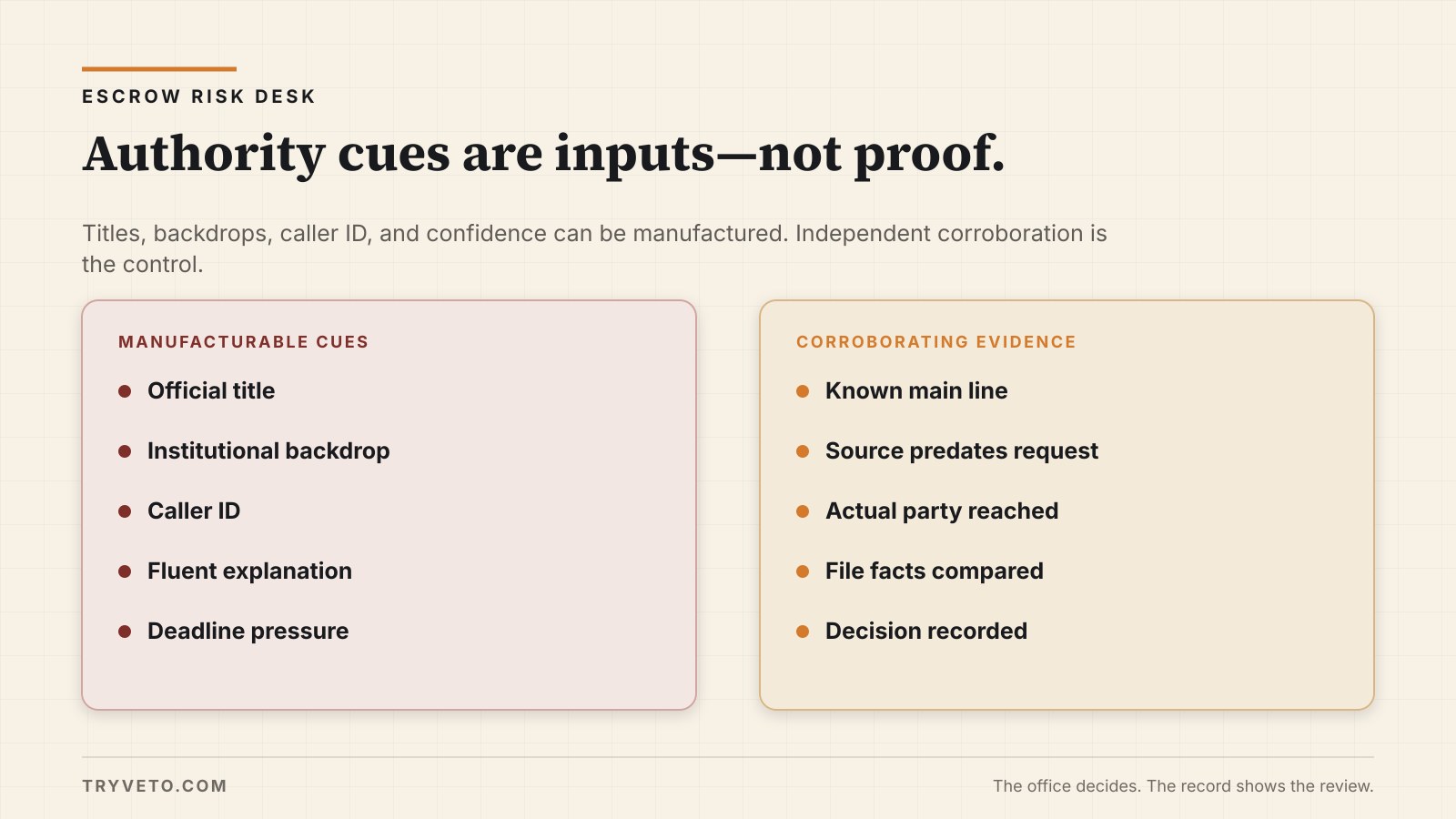
Here is what the replica makes plain. Authority, as it reaches you, is a set of cues. A uniform. A title in a signature block. A department name — "wire fraud team," "funding compliance," "special agent." Hold music and a professional transfer. Letterhead. A caller ID that reads like your seller's bank.
Every one of those cues can be produced by someone whose actual job is producing them. The Eswatini crew built a physical set. Most operations need a signature block and a confident tone.
None of this means every official contact is fake. It means the cue itself carries no evidentiary weight. It never did — the set just makes the point impossible to ignore.
The escrow version of the fake police station
In an escrow file, the fake police station shows up as sentences, not sets.
"This is City National's fraud department — we need to redirect that disbursement while we investigate." "I'm the lender's closing manager; the payoff instructions were updated this morning." "This is Agent Reyes with the FBI; do not discuss this call with anyone at your office."
Each one is an authority claim used as a lever. To change where money goes. To speed a release. Or — the sharpest version — to pull the officer outside the office's own process in the name of a bigger one.
Watch the confidentiality move in particular. "Do not discuss this with your coworkers" sounds like procedure. Its function is to switch off the office's second set of eyes at the exact moment they matter. A legitimate authority almost never needs your office to stop being an office.
The tell is structural, not tonal. A legitimate request survives your procedure: it can be confirmed through a channel you already had, against documents already in the file, on a timeline that permits the check. An authority claim that requires you to skip the file — urgent, confidential, outranking your process — is asking you to substitute their cue for your evidence.
As we found reading years of DFPI enforcement records, the state judges the file, not the persuasiveness of whoever called.
What should be written down before money moves
Before the money moves, the file should answer five questions:
- What changed.
- What was checked, and against which source.
- What stayed open.
- Who reviewed.
- What the office did.
When the change arrives carrying an authority claim, the record gets specific. Who claimed what, in their words — name, title, organization, channel. How the office corroborated the claim through a source independent of the requester — a number from the file or the institution's published main line, never one supplied in the request, with the source row noted. What in the existing file the request was checked against, and what matched. Anything the caller's confidence could not close, retained as an open item. And the office's decision — proceed, or hold pending an owner exception — with reviewer and time.
If the request forbade contacting others, or demanded the office's process be bypassed, write that down too. It is the most diagnostic fact on the page.
Operator takeaway
Treat every title as a claim awaiting a file check — especially the intimidating ones, because urgency plus authority is the exact product the replica-station business model exists to manufacture.
Check the claim against what the office already holds. Write down how.
They can build the uniform.
They cannot build your record.
— Sebastian Heyneman
Sources
- Over 5,800 arrests, USD 293 million intercepted in global fraud bust (INTERPOL, July 9, 2026)
- Related on this blog: How California Escrow Companies Actually Lose Their Licenses
Boundaries: figures and case details are as reported by INTERPOL; amounts are INTERPOL's, in US dollars as stated. The operation targeted consumer-facing fraud — no escrow office appears in the release. Mapping the tactic onto the escrow desk is our reading.
See a sample Review Record.
One page showing what changed, what was checked, what stayed open, and who reviewed it.