
The Callback Was Built for a Slower Internet
GPT-Live makes voice AI conversational and normal. For escrow, 'it sounded fine' is a weaker record than ever. What a documented callback should capture before a wire is released.
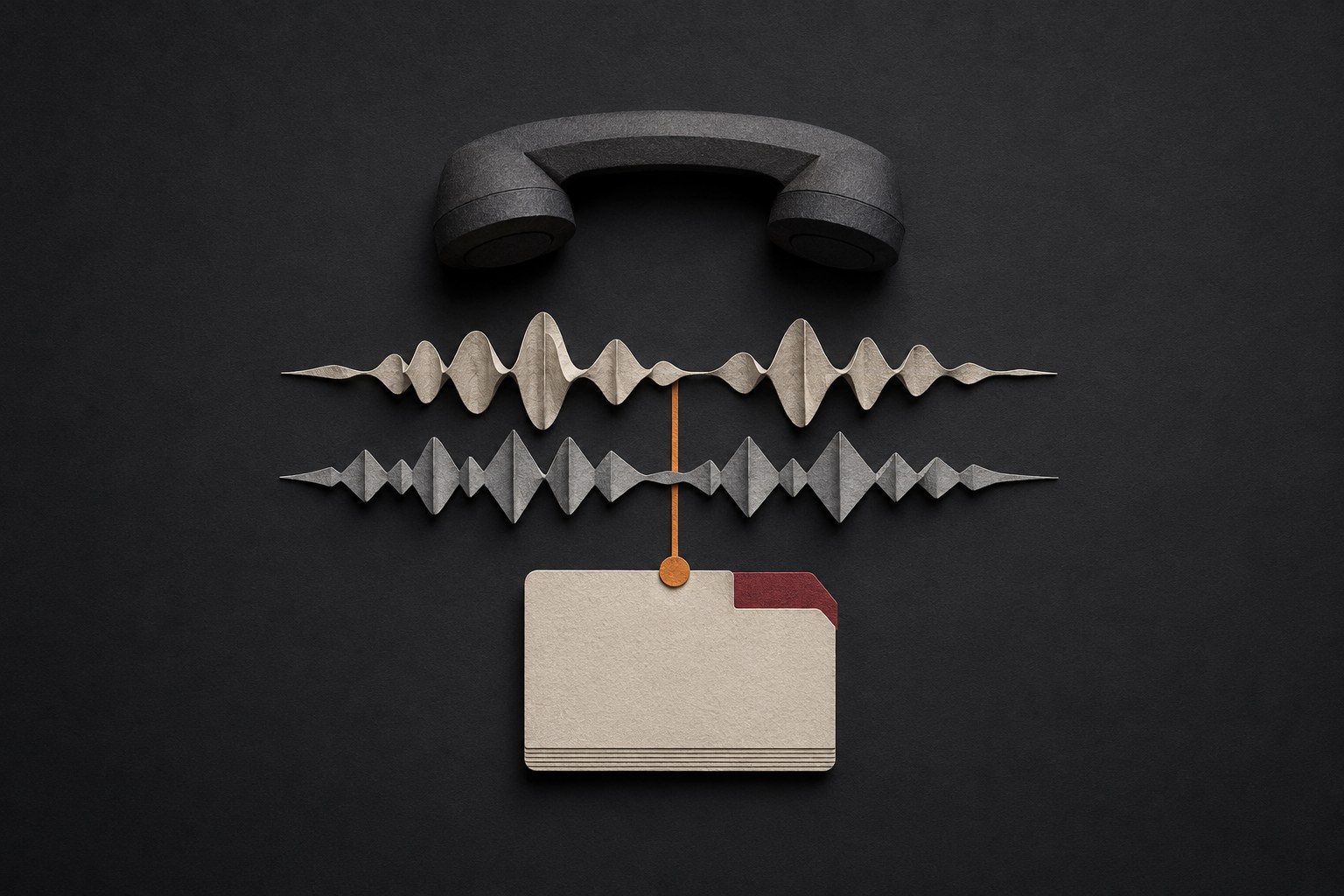
On July 8, OpenAI shipped a voice model that says "mhmm" while you talk.
GPT-Live now powers ChatGPT Voice. OpenAI says more than 150 million people use Voice and Dictation weekly. The company calls the architecture full-duplex: it listens and speaks at the same time, decides many times a second whether to talk, pause, or stay quiet, and hands harder questions to a larger model in the background without breaking the conversation.
OpenAI says talking to it should feel like talking to a person. For 150 million people a week, it now does.
Two things this story is not. It is not about a cloning tool — GPT-Live uses predefined voices, and OpenAI says it built safeguards specifically so it cannot imitate a real person. And it is not a claim that this product will be used against an escrow desk.
It is about a baseline. Less than two weeks earlier, OpenAI previewed GPT-5.6, its next flagship, capable enough at sustained work that the company staged the release behind extra safeguards. Fluent, natural, tireless machine conversation — by voice, at length, in real time — is becoming ordinary software behavior.
Why escrow should care
Escrow's exposure runs through phone calls at the worst moments. A payoff bank "confirming" new instructions. A seller "correcting" an account number the day before funding. A lender's "closer" pushing a change through.
On every one of those calls, officers have always drawn some comfort from how the call sounded. That comfort is losing value on a schedule the office does not control.
The parts of the callback that were always sound — independent number, named person, specific facts, discrepancies kept visible — are becoming the entire control. And they are the only parts an examiner, a carrier, or a courtroom can look at later.
What the callback was actually testing
The callback became escrow's standard control in an era when it tested two things at once, and nobody had to separate them.
First, an independence check: you dialed a number you already trusted, not one handed to you. Second, a plausibility check: a human listened to another human and judged whether the voice, the manner, and the answers sounded right.
For decades the second check quietly did a lot of the work. An officer who knew the seller's voice, or who felt the caller sounded like a real bank employee, treated that impression as confirmation. And to be fair, it usually was — because sounding human, at conversational speed, on an unscripted call, used to be hard.
That difficulty is what is evaporating. Not because any one product is built to deceive — GPT-Live is not — but because natural voice is becoming a default interface. The more normal fluid machine conversation gets, the less any ear can carry evidentiary weight.
"It sounded normal" is turning into a description of the entire phone network.
The half of the control that survives
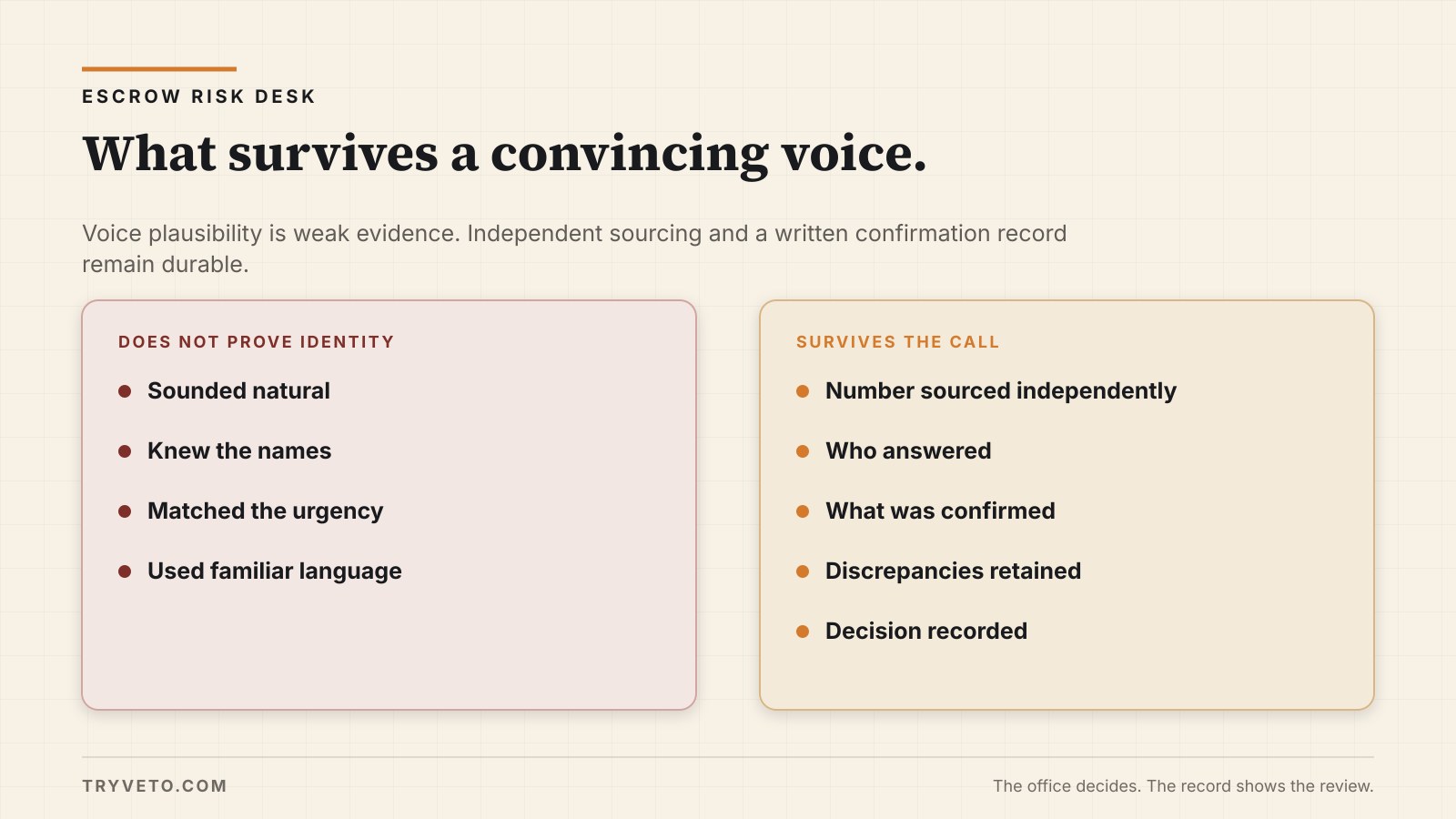
Here is the good news, and it is real: the strong half of the callback was never the ear. It was the independence of the channel and the specificity of what was confirmed. Those survive — but only on paper, because they are also the only parts anyone can examine later.
Consider two file notes about the same call.
Note one: "Called seller, confirmed wire change, OK to proceed."
Note two: "Called seller at (714) number from opening package dated 3/12 — source row: office file, not the number in the 6/30 change email. Reached Maria R., confirmed last four of new account, confirmed she initiated the change, confirmed property address and closing date. Open item: bank name on new instructions differs from bank named on call — retained open. Reviewed by DK, 2:12pm. Office decision: hold pending resolution."
The first note records a feeling. The second records a review.
Neither note depends on how anyone sounded. The second would hold its value if every voice on every call were synthetic, because nothing in it rests on an ear. If the call was fraudulent, the discrepancy line is where it shows. If it was clean, the office holds a page showing what a careful review looked like — which, as our post on the November voice-impersonation loss covered, is the part the office actually controls.
A callback is no longer enough unless the record shows how it was performed. Same call. Different evidence.
What should be written down before money moves
Before the money moves, the file should answer five questions:
- What changed.
- What was checked, and against which source.
- What stayed open.
- Who reviewed.
- What the office did.
For a confirmation call, that means the number dialed and its source row — where in the file it came from, and that it was not supplied with the change being confirmed. The name of the person reached. The facts confirmed, listed, not summarized as "details confirmed." Anything that did not match, retained as an open item. The reviewer and the time. The office's decision: released, or held pending an owner exception.
A call that cannot fill in the first line — where the number came from — was not an independent check, however natural it sounded.
Operator takeaway
Whatever you think AI will or will not do to phone calls, the file does not care how the call sounded. Keep making the calls. Stop trusting your ear, and stop letting the call vanish into "confirmed, OK to wire."
Six lines per call is the difference between a control and a custom.
The callback was built for a slower internet.
The documented callback is built for this one.
— Sebastian Heyneman
Sources
- Introducing GPT-Live (OpenAI, July 8, 2026)
- Previewing GPT-5.6 Sol (OpenAI, June 26, 2026)
- Related on this blog: A familiar voice is no longer a control
Boundaries: product details and the 150-million figure are OpenAI's own, from its announcements, dated above. GPT-Live is built for conversation, not impersonation, and nothing here says otherwise. The claim that ears are losing evidentiary weight is our judgment about a baseline, not a report of any incident involving this product.
See a sample Review Record.
One page showing what changed, what was checked, what stayed open, and who reviewed it.